

Loddon Displays Screen Print
Screen Printing
INTRODUCTION
Screen printing was first invented in 1000BC in China. The original screens were made out of silk but in recent years silk has been superceded by artificial materials for the mesh. The principal has remained the same - where the mesh has been blocked out it does not allow the ink through and where the mesh has not been blocked out the ink flows through freely. Once the screen has been prepared, it is placed on a printing frame on a table. The paper or other material is placed under the screen and the ink is applied with the help of a squeegee made of rubber, which is dragged with a certain amount of pressure across the screen. For additional colours new screens have to be prepared and printed in the above manner.
THE ADVANTAGES OF SCREEN PRINTING
Screen printing is a flexible medium which can print on to various surfaces which would not be possible by offset litho. For example, screen printing can be applied not just to paper and card, but to PVC and many other plastics, glass, metal, wood, fabric, etc. and onto numerous different shapes and sizes. Because of this, screenprint is the favoured medium for point of sale and enjoys a wide variety of promotional uses. Whereas digital printing and computer-generated large format printing have been making inroads into the traditional screenprint market, none of these have been able to match the vibrancy of colour available through the screenprint process.
Stage 1: Preparing the screen
The first state in the process of screen printing is to prepare the screen. This is done by carefully washing the screen removing all traces of ink and stencil materials from the last print job. Once the screen has been thoroughly cleaned, it is coated with a light-sensitive emulsion to make the stencil.
Stage 2: Placing the film positive on the screen
After preparing the stencil, the film positive is placed on the screen (1, 2 & 3) and subjected to intense light which hardens the emulsion (4). Where the opaque film positive blocks out the light, the stencil material remains vulnerable. After subjecting the screen to the light the stencil is once again washed out removing the unhardened parts of the stencil (5). Once the excess emulsion has been removed, the screen is finally placed in a hot air drier prior to printing (6)
Stage 3 - Part 1
| The dried screen is clamped into the master frame and located in position on the material to be printed. Each colour will have its own screen and be printed in sequence. This is why an accurate registration of each colour is crucial to the overall print. |
Stage 3 - Part II
Once the screen has been placed on the master frame, the squeegee - a firm rubber strip encased in a metal or wooden holder - is clamped onto the printing arm. In this case the squeegee is being fixed onto a sem-automatic screenprinting machine.
Stage 3 - Part III
After accurate colour-matching, the ink is poured onto the screen. A wide variety of inks is available for different materials. In some cases it may be necessary to carry out adhesion tests prior to the production run.
Stage 4 - Part I
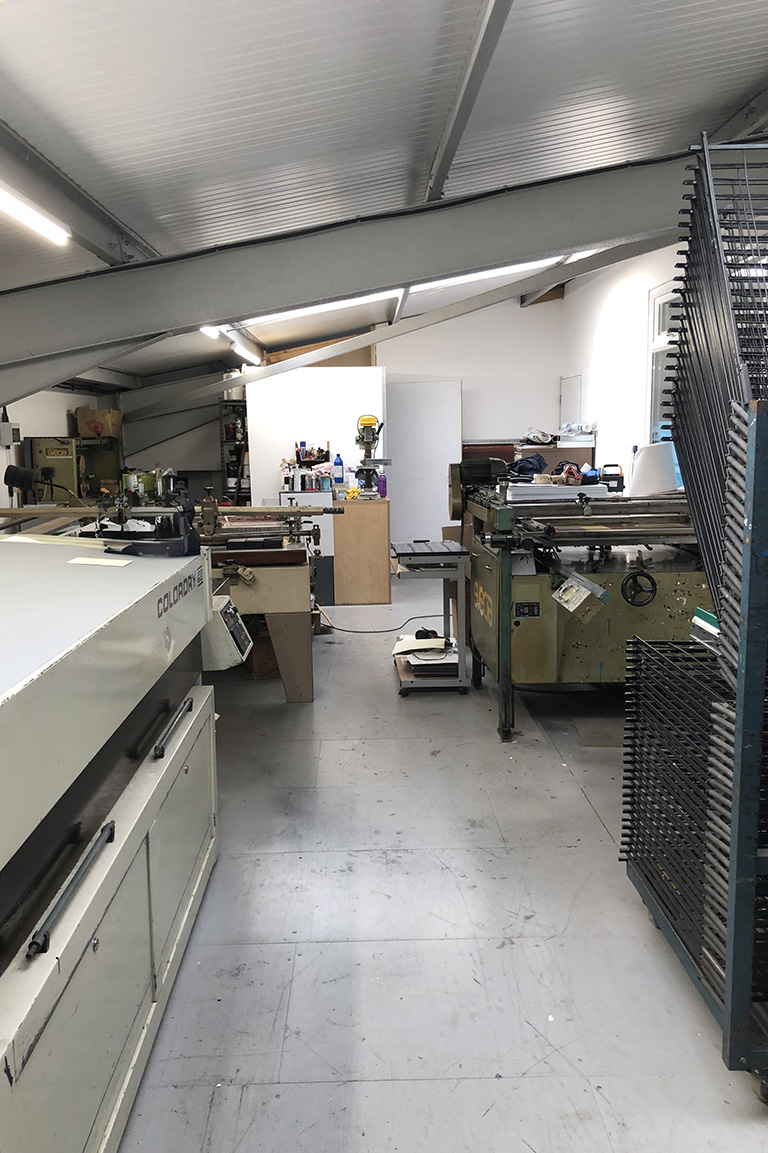
This manually-fed semi-automatic machine can produce approximately 700 prints per hour. Once the sheet has been placed on the table, air suction holds it in place as the table moves automatically under the stencil while the squeegee moves forward in unison pushing the ink through. Automatic grippers take the material into a jet air drier.
Stage 4 - Part I
A manual press is essential for certain applications but the principal is the same. Large or heavy sheets and short print runs are best suited to the manual process. The operator controls a smooth flow of ink through the stencil by applying consistent pressure. The counter balancing weights at the back remove some of the strain.
The Product
You may be walking by our prints in many places and never know it. Use our services and discover your product placed on surfaces you didn't imagine possible and in places you didn't expect.
Find new channels and new expressions for your product. Be inspired!
Find out what we can do for you!
We are laser-focused on our customers.
We don't just develop your design, we build your presence and promote your brand everywhere.

Bespoke, Versatile, Quality - Print Services